How to Keep Your Dog Active When It Gets Dark Earlier

Share


How to Keep Your Dog Active When It Gets Dark Earlier
When the clocks fall back and the sun sets before you’ve finished work, the evening dog walk suddenly happens in the dark. Shorter days throw off a routine that ran fine all summer, and plenty of dogs end up under-exercised and restless through fall and winter as a result. The good news is that your dog’s needs haven’t changed, only the daylight has, and a few adjustments keep them just as active once the evenings close in. Here’s how to keep the exercise going safely after dark, indoors, and with a little help when your schedule won’t cooperate.
Why Does My Dog Need Exercise When the Days Get Shorter?
Dogs need regular physical activity and mental stimulation year-round, and that doesn’t taper off just because the days got shorter. A dog who’s used to a daily walk still needs one in November, and skipping it tends to show up as pent-up energy, boredom, and the behavior problems that follow.
Do dogs need less exercise when it gets dark earlier? No. The season doesn’t lower how much activity a dog needs, even if it makes fitting it in harder. What a given dog requires depends on the individual, and factors like age, breed, size, health, and energy level all feed into it. A young working breed needs far more than an older lapdog, in winter exactly as in summer. The task isn’t to cut your dog’s exercise for the season, but to find new ways to deliver the same amount.
How Much Exercise Does a Dog Need Each Day?
There’s no single number that fits every dog. Most dogs do well with somewhere between thirty minutes and two hours of activity a day, but that range is wide for a reason, and where your dog lands depends on a handful of things:
- Age. Puppies need frequent short bursts, adult dogs need the most sustained activity, and seniors usually need gentler, shorter sessions.
- Breed. Working, herding, and sporting breeds were bred to go all day, while many toy and flat-faced breeds tire quickly.
- Size. Size interacts with breed more than it stands alone, since a small terrier can out-energize a large, mellow breed.
- Energy level. Even within one breed, individual dogs run from couch-loving to relentless.
- Health and mobility. Arthritis, heart conditions, and recovery from injury all change what’s appropriate, so check with your vet when health is a factor.
- Temperament. Some dogs settle happily after a short outing, others need a real job to wind down.
If you’re unsure where your own dog falls, your vet can give you a target suited to their age, breed, and condition. From there it’s about hitting that number however the season allows.
Is It Safe to Walk Your Dog After Dark?
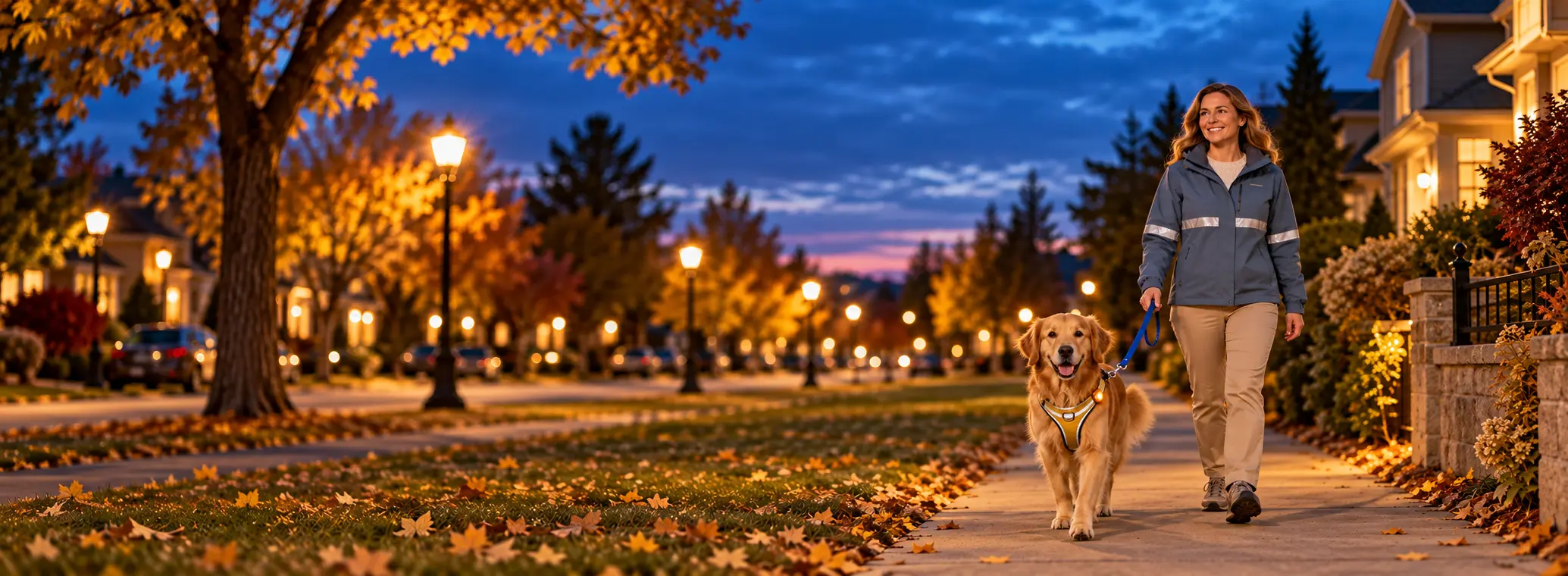
Walking your dog after dark is safe when you plan for the lower visibility. The main risk isn’t the darkness itself, it’s that drivers, cyclists, and you can’t see as well, so the whole job is making yourself and your dog easy to spot and sticking to ground you know.
A few habits cover most of it:
- Put reflective gear or a light on both you and your dog.
- Choose well-lit routes with sidewalks over dark, unfamiliar paths.
- Keep your dog on a secure, non-retractable leash so they stay close.
- Stay alert for traffic and cyclists, who may not see you until late.
- Skip unfamiliar areas after dark, where footing and surroundings are an unknown.
- Carry a flashlight or headlamp to light the path and any mess to clean up.
- Be aware that wildlife is more active at dusk and night in many areas.
- Check the weather and the ground, since ice and wet leaves hide in the dark.
What Should My Dog Wear for a Night Walk?
Gear up your dog so they’re visible from a distance. A reflective harness, collar, or vest catches headlights, and a small clip-on LED light or a light-up collar makes your dog obvious even where streetlights are thin. In cold weather, a short-coated or small dog may also want a warm coat or sweater, since a dog who’s shivering won’t enjoy the walk and may cut it short. Keep the leash secure and easy to grip with gloves on.
How Can I Make My Dog More Visible at Night?
Layer a few light sources rather than relying on one. Reflective gear works by bouncing back a car’s headlights, while an LED collar or clip light glows on its own and doesn’t need another light to be seen. Light-up leashes add another visible line, and wearing something reflective yourself helps drivers register that a person and a dog are there together. On an unlit street, the goal is simple: a driver should pick you both out well before they’re close.
How Can I Keep My Dog Active Indoors?
When it’s too dark, cold, or icy for a proper walk, indoor activity picks up the slack. The trick is that mental work tires a dog out as effectively as physical exercise, often faster, so an evening of games and puzzles can leave your dog as satisfied as a long walk would.
Play Interactive Games
Classic games burn energy in a small space. A hallway makes a decent fetch lane, tug gives a strong dog a real workout, and hide-and-seek, where you duck out of sight and call your dog to find you, blends movement with mental effort. Find-it games, hiding a toy or treat for your dog to sniff out, tap into the nose work dogs love and wear them down nicely.
Use Puzzle Toys and Food-Based Enrichment
Puzzle feeders and treat-dispensing toys make your dog work for a reward, which is both engaging and calming. Try serving part of dinner in a puzzle toy or a snuffle mat instead of a bowl, so an ordinary meal becomes ten or fifteen minutes of problem-solving. Rotate a few options so the novelty doesn’t wear off.
Practice Training and New Tricks
A short training session is deceptively tiring, since concentrating hard is work for a dog. Run through known cues, teach a new trick like spin or roll over, or polish up skills like settling on a mat. Ten focused minutes with good treats can take the edge off a wound-up dog, and it sharpens their manners as a bonus.
Create an Indoor Obstacle Course
Set up a simple course with what you have at home. Cushions to climb, a broom across two chairs to step over, a blanket draped into a tunnel, and you can lead your dog through with treats. It gets them moving, thinking, and using their body in new ways, all in the living room.
Schedule Short Play Sessions Throughout the Evening
You don’t have to deliver all the activity in one block. Several short bursts spread across the evening, a few minutes of tug here, a puzzle toy there, a quick training round later, keep your dog engaged and stop boredom from building. For a lot of households, scattering the activity fits the evening better than finding one long stretch anyway.
How Can I Keep My Dog Active If I Work Late?
The hardest version of this problem is arriving home after sunset with no daylight left and not enough time for a real walk. A dog who’s been alone all day needs an outlet, and the evening alone often can’t supply it. A few options bridge the gap:
- Hire a dog walker to come midday or late afternoon, so your dog gets a solid walk in while it’s still light.
- Use dog daycare on your longer days, where your dog burns energy socializing and playing under supervision.
- Arrange pet sitting for a check-in and some activity while you’re out.
- Ask a trusted neighbor, friend, or family member to handle an afternoon walk.
- Lean on enrichment before and after work, like a puzzle-toy breakfast and an evening of indoor games, to round out whatever outdoor time you manage.
What should I do if I don’t have time to walk my dog during the day? Arrange for someone else to, or shift the big activity to when you can be there. A midday dog walker or a daycare day keeps your dog moving during daylight, and enrichment at either end of your workday fills the rest. The point is that your schedule doesn’t have to shortchange your dog, as long as the activity comes from somewhere.
Can a Dog Walker Help When It Gets Dark Earlier?
A dog walker is one of the simplest fixes for the shorter-day problem. A professional walker can come while the sun’s still up, so your dog keeps their normal midday or afternoon walk no matter how early it gets dark on your end. Your dog gets exercised during daylight, and you come home to a calmer, already-walked companion instead of one who’s been waiting all day to move.
Scheduling that daytime walk also takes the pressure off your evening, which means your time together after work can be play and company rather than a rushed trip around a dark block. For high-energy dogs especially, a reliable daytime walk through the dark months is often the difference between a settled dog and a restless one.
Need help fitting a walk into your schedule? Yourgi can connect you with local dog walking providers who can keep your dog active while you’re at work or tied up with other commitments, all backed by the Yourgi Guarantee.
What Are the Best Activities for High-Energy Dogs in Fall and Winter?
High-energy dogs need more than a quick turn around the block, and the short days hit them hardest. For a dog bred to run, a five-minute potty walk won’t cut it, so build the season around bigger outlets:
- Longer daytime walks on weekends and whenever your schedule allows, to bank real mileage while there’s light.
- Hiking on open days, which combines distance with the mental workout of new terrain and smells.
- Fetch and structured play, run hard enough to actually tire a fit dog.
- Training and dog sports like agility, which challenge body and mind together.
- Puzzle toys and enrichment to top off the mental side on low-daylight days.
- Dog daycare, where a high-drive dog can romp and socialize for hours under supervision.
- Supervised play with other dogs, since a good play session with a well-matched buddy burns energy fast.
For these dogs, daycare and playgroups earn their keep in winter. A couple of daycare days a week can absorb the energy that a dark, cold week otherwise leaves bottled up.
How Can I Tell If My Dog Isn’t Getting Enough Exercise?
An under-exercised dog usually tells you, often through behavior rather than words. Common signs include:
- Restlessness and trouble settling down
- Destructive behavior like chewing or digging
- Excessive barking
- Attention-seeking and pestering
- Pacing or an inability to relax in the evening
- Weight gain over time
- Obvious boredom
Read these as a possible clue, not a verdict. The same behaviors can come from anxiety, a medical issue, a change in the household, or simple boredom that more mental stimulation would fix as readily as more exercise. If your dog’s behavior shifts suddenly or seems off, it’s worth a conversation with your vet rather than just adding a lap around the block. When under-exercise really is the cause, more daily activity usually brings a visible change within a week or two.
Create a Fall and Winter Exercise Routine for Your Dog
A simple routine keeps the activity consistent once daylight gets scarce. Here’s a sample framework to adapt to your dog and your schedule:
- Morning: A short walk and bathroom break to start the day, while there’s a little daylight.
- Afternoon: A dog walker or a daycare day covers the main exercise during light hours, especially if you’re out.
- Evening: Indoor play and enrichment, like a puzzle-toy dinner, a training session, or a few rounds of tug and find-it.
- Weekend: A longer daytime walk, a hike, or an outdoor play session to bank the bigger activity while you have daylight and time.
Adjust the balance to your own dog, heavier on the physical side for a high-energy breed, gentler for a senior, and the routine holds their activity steady straight through the darkest part of the year.
Frequently Asked Questions About Exercising Dogs After Dark
How do I exercise my dog when it gets dark early?
Mix safe after-dark walks with indoor activity and daytime help. Use reflective gear and lights for evening walks, fill in with indoor games, puzzle toys, and training, and consider a daytime dog walker or daycare so the main exercise happens in daylight. The aim is to keep the total activity steady even when the sun sets early.
Is it safe to walk my dog after dark?
Yes, with the right precautions. Make yourself and your dog visible with reflective gear and lights, stick to well-lit, familiar routes, keep your dog on a secure leash, and stay alert for traffic, cyclists, and wildlife. Most of the risk comes from low visibility, so being easy to see handles the biggest part of it.
Do dogs need less exercise in fall and winter?
No. A dog’s exercise needs stay about the same year-round. Shorter days make the routine harder to fit in, but they don’t reduce what your dog requires. Under-exercising through winter tends to lead to restlessness and behavior problems, so it’s worth finding indoor and daytime options to keep the activity up.
What are good indoor exercises for dogs?
Fetch down a hallway, tug, hide-and-seek, find-it games, puzzle feeders, training sessions, and a homemade obstacle course all work well indoors. Many of these tire a dog through mental effort as much as physical movement, which makes them a strong substitute when it’s too dark or cold to get outside.
How can I keep my dog mentally stimulated indoors?
Lean on puzzle toys, snuffle mats, training and new tricks, and nose-work games like hiding treats for your dog to find. Feeding meals through a puzzle instead of a bowl is an easy daily win. Mental work is tiring in the best way, so a good enrichment session often settles a dog as well as a walk.
How can I keep my dog active if I work late?
Arrange for exercise during daylight when you can’t provide it yourself. A midday or afternoon dog walker, a daycare day, or a trusted neighbor can give your dog a real walk while it’s light, and enrichment before and after work fills the gaps. That way an early sunset doesn’t leave your dog under-exercised.
How much exercise does my dog need each day?
It varies by dog. Many do well with thirty minutes to two hours a day, but the right amount depends on age, breed, size, health, and energy level. A high-energy working breed needs far more than an older or low-key dog. Your vet can help you set a target that fits your dog.
Should I hire a dog walker if I can’t walk my dog during daylight?
It’s one of the easiest solutions. A professional walker can come while the sun’s up, so your dog keeps a normal daytime walk no matter how early it gets dark after work. That keeps your dog’s routine and energy steady through fall and winter and takes the pressure off your evenings.